When XYZ Manufacturing finally transitioned to a professional partner, they didn’t just save money; they gained a dedicated layer of defense. They moved from a reactive model, where HR was managing guards to a proactive model, where security became a specialized, measurable business function.
7 Benefits of Outsourcing Security Services
Outsourcing is not just about “hiring guards”, it is about integrating a business utility that functions with the same rigor as your IT or Finance departments.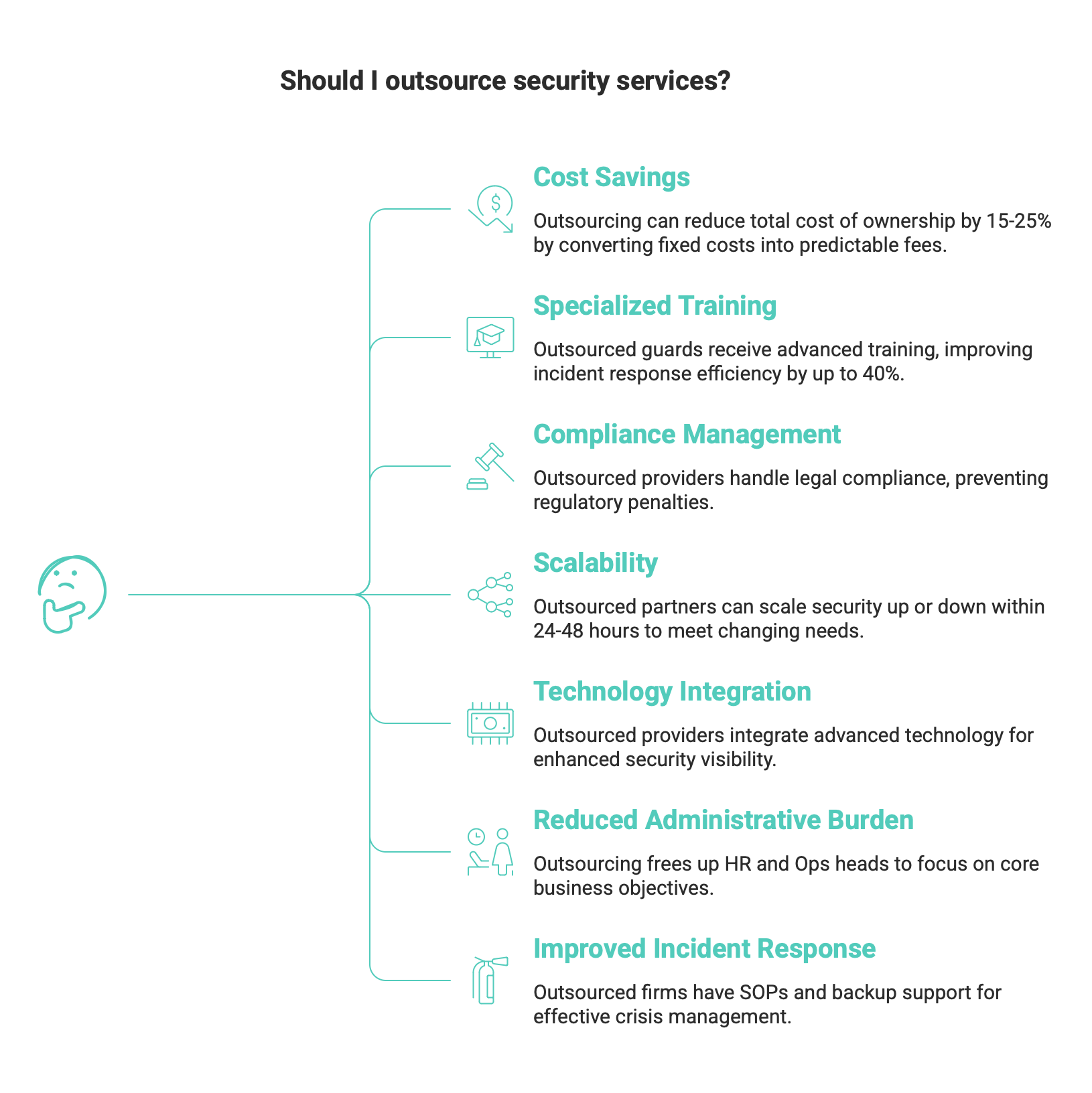
1. Measurable Cost Savings
Maintaining an internal team incurs “hidden costs” that rarely make it to the initial budget sheet. These include recruitment, background checks, training, uniforms, insurance, and long-term statutory obligations like PF, ESI, and gratuity. Outsourcing effectively converts these fixed, rising costs into a predictable service fee, typically resulting in 15–25% reduction in total cost of ownership.
2. Access to Specialized Training
In-house teams rarely receive the depth of training required for modern threat landscapes. Professional firms operate centralized training academies, ensuring guards are proficient in access control, fire safety, conflict resolution, and emergency evacuation protocols. Trained guards improve incident response efficiency by up to 40% compared to untrained internal hires.
3. Seamless Compliance Management
India’s labor laws and PSARA (Private Security Agencies Regulation Act) requirements are complex and strictly enforced. Managing these requirements in-house creates a massive administrative burden. Outsourced providers assume the legal liability for labor compliance, ensuring all guards are verified, licensed, and legally employed, insulating your business from regulatory penalties.
4. Scalability on Demand
Business needs are rarely static. Whether you are ramping up for a festive season, opening a new warehouse, or hosting a high-profile corporate event, in-house teams struggle to flex. Professional security partners have a deep bench of personnel, allowing you to scale up or down within 24–48 hours, ensuring you only pay for the security presence you actually need.
5. Technology Integration
Modern security isn’t just boots on the ground, it’s digital. Reputable providers integrate security guards with advanced surveillance, biometric access, and AI-enabled incident reporting tools. This “Man + Tech” approach provides data-backed visibility into facility safety that is impossible to achieve with a manual, in-house team.
6. Reduced Administrative Burden
Every hour your HR or Ops heads spend settling guard disputes, managing payroll, or handling absenteeism is an hour lost on core business objectives. Outsourcing transfers the entire operational burden – scheduling, supervision, and performance monitoring, to the provider. You stop being a “security supervisor” and start being a client, managing outcomes instead of individuals.
7. Improved Incident Response
In a crisis, experience matters. Professional agencies have robust Standard Operating Procedures (SOPs) developed over years of managing diverse environments. From rapid fire suppression to handling workplace disturbances, a professional firm provides a structured chain of command and backup support that solitary in-house guards simply cannot match.
ROI Breakdown: Beyond the Monthly Invoice
To truly understand the ROI, we must look at the “hidden” costs of an in-house model versus the transparent pricing of a professional partner.
- Recruitment & Attrition Costs: High turnover in security is standard. The cost of hiring and replacing a single guard, including advertising, vetting, and onboarding time, can reach 1.5x their monthly salary. Outsourced partners bear this cost.
- Supervision Overhead: An in-house team needs a supervisor. Who manages the supervisor? Outsourcing eliminates this management layer entirely.
- Statutory Penalties: A single compliance lapse regarding PF or ESI can lead to fines and legal action. Outsourced providers carry this risk, protecting your company’s balance sheet.
When you account for the administrative time reclaimed and the reduction in theft/incident losses, the financial impact is clear: outsourcing transforms security from a “sunk cost” into a strategic operational investment.
Case Example: Deploying an Integrated Hybrid Model for a Tier-1 Electronics Manufacturing Hub.
The Context: A global electronics leader required 24×7, high-stakes security for a facility managing 10,000+ employees and sensitive manufacturing intellectual property (IP).
The Problem:
- Access Bottlenecks: Maintaining high-speed throughput for 10,000+ staff.
- Security Gaps: High risk of pilferage in loading zones and unauthorized access to critical IP-restricted areas.
- Monitoring Scale: Difficulty in maintaining 24×7 vigilance over a massive, complex campus.
The Transition: Partnered with Terrier Electronic Security Solutions (TESS) to deploy a fully Integrated Hybrid Model:
- Man-Tech Convergence: Unified 300+ security personnel with a 500+ AI-enabled camera network via a centralized command center.
- Intelligent Access: Implemented IP-based facial recognition (FR) and ANPR boom barriers for frictionless, verified entry/exit.
- Proactive Defense: Shifted to AI-driven video analytics to monitor loading bays and restricted zones in real-time.
The Measurable Outcomes:
- Throughput: Achieved seamless, high-speed employee authentication.
- Integrity: 100% restricted zone compliance; zero unauthorized IP access.
- Proactivity: AI-driven alerts enabled real-time interception of pilferage attempts, significantly outperforming manual monitoring.
Why Businesses Choose Terrier
At Terrier Security Services, we do not view security as a commodity. We view it as an integrated business enabler. We provide more than personnel, we provide a robust security framework.
- Structured Deployment: We go beyond just placing guards, we conduct site-specific threat assessments to design your perimeter and internal security strategy.
- Training Excellence: Our personnel undergo rigorous, certified training programs, ensuring they are prepared for India’s unique operational challenges.
- Compliance Certainty: We handle all statutory obligations, ensuring your business remains insulated from labor law complexities.
- Tech-Enabled Oversight: Our monitoring systems provide you with real-time reporting and accountability, ensuring you always have total transparency into your security posture.
Ready to move from reactive management to proactive protection? Contact us today for a site assessment.